James Clear - Atomic Habits
# James Clear - Atomic Habits
## Jonathan Stark:
Hello, and welcome to The Business of Authority. I'm Jonathan Stark.
## Rochelle Moulton:
And I'm Rochelle Moulton.
## Jonathan Stark:
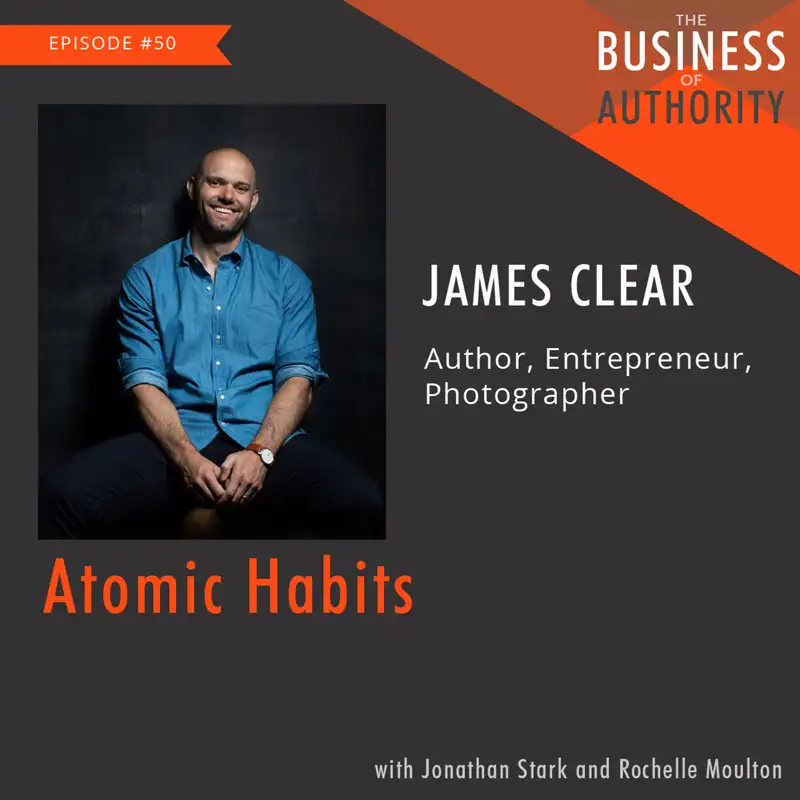
And today we're joined by author and speaker James Clear. More than 400,000 people subscribe to James's newsletter on habits and performance. His work's been used by teams in the NFL, the NBA, and MLB, as well as leaders of Fortune 500 companies.
His new book, Atomic Habits: Tiny Changes, Remarkable Results, is available now. James, welcome to the show.
## James Clear:
Thanks a lot for having me. It's great to be here.
## Jonathan Stark:
So for folks in the audience who, uh, maybe are hearing your name for the first time, can you tell them a little bit about who you are and what you do?
## James Clear:
Sure. So I've been an entrepreneur for, uh, coming up on eight years now. Uh, for the last five-plus years I've been writing about the science of habits and how habits are formed and how we can do better work and live more productive lives. I originally got into this topic as an athlete, so I played baseball through college and, um, I was sort of exposed to habits, like most athletes are, without really knowing it.
Like, there were all kinds of things we had to do at practice each day. Um, and, uh, it was only afterward looking back that I realized all the things that w- I was following, and that happened because I, uh, I was a science major in undergrad. I got done and went to business school, and I had this idea to start my own company, and, uh, when I left I I launched it and nobody bought anything.
Nobody... It didn't go anywhere, and, uh, I realized, oh, the reason that people aren't buying anything is because I, I don't know how to market it. And so I started studying consumer psychology, and that led me to behavioral psychology and habit formation and, uh, gradually I, I did learn, uh, how to build a successful business, but along the way I also learned what it means to build successful habits in general.
And so this book is sort of the culmination of five-plus years of work in that field, both employing it in my own business and life and, uh, researching and reading and writing about it for, uh, the writing that I do each week at jamesclear.com.
## Jonathan Stark:
Excellent. So, so I noticed that, uh, and correct me if I'm wrong, but, the, your, uh, do you call it your email list, your newsletter?
## James Clear:
Sure, yeah. Either one is fine.
## Jonathan Stark:
Yeah, okay. So I mean, it's, it's a very popular list, and I- I'm been a subscriber for a long time. I've gotten a lot of great stuff out of it. It's super effective. Definitely works for me. Um, you know, the principles that you share there. Do you think that you could have, you know, let's say written this book without having done, done what you've done on the list first, or does it feel like a precondition for you to have kind of worked out your ideas in, in public, air quotes, uh, to get to this place where you could put together, you know, 50,000 words on the subject?
## James Clear:
Hmm. Well, it's a good question. I don't... So first, I don't think that I needed to have, you know, an audience of hundreds of thousands or millions of people, uh, in order to have written the book. But I will say that for any long-term project, and this is particularly true for me, my brain seems to be... Like I, I seem to do well with things that are daily or weekly, like going to the gym five days a week or writing an article every week or something like that.
That kind of feels like it's in my wheelhouse. Anything longer than that, it can be a real slog, and, uh, is particularly hard for me to get through. So writing this book, which took three-plus years of research and two-plus years of writing, I mean, it really probably has been five- more than five years start to finish, um, was very challenging.
And if I didn't have the feedback of, you know, hundreds of people signing up every day or thousands of people reading articles every time I sent them out, then I- it probably would've sapped my motivation. So in that sense- Mm-hmm ... having a large audience was really, it was, kinda helped. It, it gave me the feedback I needed to keep going.
Um, as far as testing my ideas in public goes, that was very helpful. Uh, you know, what I realized early on that first... And this is, uh, the unsexy punchline to how I grew my business in the beginning. I, I wrote two articles a week for three years. Every Monday and Thursday, I would put out... And I would spend, uh, you know, writing an article is not like a one or two or three-hour affair for me.
It's every article is at least eight to 10 hours. Many of them take upwards of 15 to 20, and the really long ones are 30 or 40 hours a piece. So, uh, you know, I w- it was a full-time job to write two good articles a week for me, and I did that for three years. And eventually, what I came to realize was that at the end of each month, I would have eight or nine, uh, at the end of each month, and I didn't know which ones were gonna be good, but two or three of them would be.
And so that was a little bit of a lesson to me that like, uh, this is especially true for a lot of creative projects. You can sort of be a terrible judge of your own work, and the real goal is to try your best each time and show up each day. And if you do that, then eventually you can look back at, at some span of time, a week or a month or a year, and you'll be surprised by the good ideas that come out.
But you couldn't necessarily predict them, uh, beforehand. And so when it comes to writing this book, it did help me to test those ideas in public and see what are people interested in, what resonates with a wide range of people versus what is just kind of unique to my personal experience. So I was able to start with, uh, I think, a better backbone of ideas for the book because I had tested things publicly for two or three years.
## Jonathan Stark:
Yeah, that makes a lot of sense. So w- what are some of the really big ideas in the book?
## James Clear:
Well, there are a few core themes. Uh, one core theme is that small changes compound over time. They don't just add up a little bit. So, you know, the most typical example of this is compound interest in finance, and this idea that, you know, you sock away a little bit each year, and if you invest in the stock market, for example, and get 7 to 9% a year, then you turn around 30 years later and, uh, you're really surprised by how much money you've saved thanks to the, the power of exponential growth and compound interest.
And I think we can say something fairly similar for a lot of the habits in our lives. So for example, being the type of person who gets one extra thing done each day doesn't really seem like much on any given day, but it can count for a lot over the course of your entire career. Same way for learning.
You know, being a, a person who reads even one extra page a day or one extra chapter each week doesn't seem like much, but every additional book that you read not only gives you more ideas from that book, but also gives you new ways of looking at all the old ideas that you learned. So it sort of continues to, to multiply more and more.
And, uh, knowledge is... knowledge and productivity kinda have this compound interest-like effect to them And many of our habits, uh, sort of deliver these outsized results in that way. And so one of the core themes of the book is that you'll be surprised by how big of an impact you can make if you just make a 1% improvement each day.
If you just focus on something very tiny, but, you know, nudge that in the right direction. And, uh, and so then the question, the natural question is, well, all right, that sounds good, but how do we actually do that? And that's kind of the core focus of the book is laying out what I call a system for improvement rather than setting a goal to get better.
And so this, this idea is difference between systems and goals. A variety of people have talked about it. A lot of people will say like process over product. Um, Scott Adams, the, the illustrator of Dilbert, has brought up this idea of systems versus goals. But the way that I define it is a goal is the outcome that you want to achieve.
So for example, if you're a runner, your goal might be to run a marathon, or if you're a writer, your goal might be to write a book, or a basketball coach, your goal might be to win a championship. But your system is the process behind that. So, you know, your system for as a runner is your training program and how you recover and, uh, the group of people that you hang out with in your running club.
For the basketball coach, it's how you train your assistant coaches and recruit new players and what drills you do at practice each day. For the writer, it's how you collect new ideas and do research or the, you know, writing ritual that you have each morning to get into your, uh, your flow and start working on the next piece.
And the key punchline here, and this is, you know, one of the central ideas that the book is organized around, is we do not rise to the level of our goals. We fall to the level of our systems. And so often we think- Mm ... I just need to be more ambitious. I just need to want it more. I need to, uh, push harder.
But if you find that bad habits or a lack of productivity is persisting in your life, it very rarely is because you don't want to change. It's because you have the wrong system for change. And so if you can learn how to build a better system, then you can often get much better results. And in fact, your results right now in your life, your current life, the- your current results are a product of your current system.
Your... A- another way to put that is that your current life is perfectly organized for the results that you have right now. It has to be by definition .
## Jonathan Stark:
Yeah. Right.
## Rochelle Moulton:
Right. Right.
## James Clear:
So if you can reorganize that system, uh, then you can get a different outcome. And, uh, in the book, I lay out four primary ways to do that and then like a variety of applications and details about each of those four ways.
## Jonathan Stark:
So I'd love to drill into goals a little bit here since we're talking about that. Um, one of the, one of the things that really resonated with me was, you know, sort of like, um, you would say instead of s- instead of committing to lose 30 pounds, commit to, I don't know, walk a mile a day. Or so- some action that you can take so that you can f- you know, you can do the thing, it's totally under your control, and when you're done with it, you get a little bit of a, you know, you feel a win.
## James Clear:
Mm-hmm.
## Jonathan Stark:
And if you can keep doing that, then probably you'll reach the goal, but it's not thinking about the goal or trying to get motivated to, you know, do who knows what You know, it's like, it's like commit to taking an action that you have control over that will most likely lead to that goal. And the... I think the, the quote that I saw from you that really hammers this home is, I'm paraphrasing a little bit here, but it was basically, "Big goals make you feel bad about yourself now."
Could you talk about that a little bit? Or if I'm getting it wrong, you can correct me, but-
## James Clear:
Sure.
## Jonathan Stark:
So- What's this going on there?
## James Clear:
I think there are two things there that I wanna talk about. So the, the first is achieving a goal only changes your life for the moment. Um, so for example, if you, if you look at your garage and you're like, "I have this really messy garage.
I need to get this cleaned up," uh, and you feel this burst of motivation, and then you go out there on some Saturday and clean everything up. You get... You know, it's entirely, uh... It looks great. It's exactly... You achieved your goal. Um, well, you have a clean garage for the moment, but if you don't change the sloppy pack rat habits behind what led to a clean garage, uh, then you're...
Or led to a messy garage in the first place, y- three months from now you're gonna have a messy garage again. And so this is one of the... kind of one of the ironies of systems versus goals, or habits versus outcomes. We think that what we need to change are the results. We think that, "Oh, I have a messy garage and I need a clean garage."
But in fact, it's not really about that. What you need are better cleaning habits or organization habits, uh, rather than these, you know, sloppy pack rat habits that led to the outcome in the first place. So it's sort of like treating a symptom without addressing the cause.
## Jonathan Stark:
Right.
## James Clear:
Mm-hmm. And, um, at the same time, and this comes back to the, the quote that you mentioned, uh, goals kind of can provide another pitfall, which is that they perpetually delay happiness.
They make you think that, "Once I reach this milestone, then I can be happy." Uh, I did this myself for a long time. This is... And this is sort of a theme of, of most of my writing. Uh, I do think that it has wider appeal and has, uh, garnered a larger audience because we all deal with these issues. But mo- most of what I write is a message to myself in some form.
Um, and so for a long time I was so goal-oriented. Uh, I would set goals for the weights I wanted to lift in the gym, the grades I wanted to get in class, the, uh, growth that I wanted to have in my business, and I would always, you know, be internally having this monologue telling myself things like, "Oh, if I can just get featured in The New York Times, then I'll be set."
Right. Like, then my business will be moving smoothly. Um, and, uh, the, the funny thing is, you know, that has happened for me now, which I'm very grateful for. Uh, but I've been in there a few times, and it do- it's nice. It provides a little spike that day or that week, uh, but it doesn't measurably change things.
Because two or three months from now, th- that spike is gone and you're back to you need to run the system. You need to run your business. And, uh, that is so true for everything. I mean, we do that with diets all the time. We think, "Oh, if I could just lose 25 pounds, then finally I can be happy with my body."
Um, but it's not really about losing 25 pounds. It's about living a healthy lifestyle. Uh, and of course, ultimately you would like to get that result, which is the product of being in a he- healthier system. Um, and this is... So this comes back to the, the point you made about happiness, which is that if we ma- constantly make it about the goal, about the outcome, then you're c- always pushing happiness off.
Whereas if you make it about the process and say, you know, "All right, yes, I would like to lose 25 pounds," but the system or the process, what I wanna do is become the type of person who doesn't miss workouts. Well, every time you do a workout, now you can be satisfied with yourself because you're, the system is running.
You're employing that process. And so each instance of it is a, a reason for success or feeling satisfied versus only allowing yourself to feel successful once some arbitrary mark has been hit.
## Rochelle Moulton:
Well, and I think that's really important for our audience because a lot of them are solos working out of your house, and who wants to perpetually delay happiness?
It's really tough to stay engaged in your business day to day if you can't kind of feel that you're making progress towards where you wanna go.
## James Clear:
Well, this is one of the, I mentioned earlier that I h- kind of outlined four major ways to, to build a better system and, uh, kind of naturally have better habits result.
Um, and the fourth one is make it satisfying. And there, this is true for any habit. We have... It's only logical. The brain wants to repeat things that feel good or that feel successful. If you don't, if you're not having fun or enjoying it or feeling satisfied, if you don't feel like you have successfully accomplished the solution to whatever problem you're facing, then you have no reason to repeat that action in the future.
So the longer that you go feeling unsatisfied, the less likely it becomes that you stick with, uh, with that process in the long run.
## Rochelle Moulton:
Mm.
## Jonathan Stark:
It's funny you say that because right before, uh, right before we all jumped on, Rochelle and I were talking about h- writing, 'cause we're both big writer- all three of us are big writers.
But generally, I don't enjoy the, the writing, the typing part. Like, when I'm, I sit down to write, I sometimes get... I almost never get writer's block, but I'll get, like, "Ugh," you know, like, "I don't know if I'm up to this task." Like, y- you know what I mean? There's, like, a little bit of the, you know, Steven Pressfield's resistance.
## James Clear:
Sure. Writing is hard, so.
## Jonathan Stark:
Yeah. But, but when we're done, and it's like the gym too. I d- I go to the gym regularly, but I don't like it. I really don't like it. When I get out, I'm glad I did it.
## James Clear:
Mm.
## Jonathan Stark:
And it's, it creates this very, you know, it's very short-term pain for, um, a quick, a quick good feeling. So for, for things that only take an hour, 'cause both of those things from...
You know, I write every day for up to an hour, usually not more than an hour- It's, it's easy to keep a streak going because there are these sort of small, these small things I can do to get a quick hit, quick win, and then, you know, before you know it, man, you look back and wow, what a difference after six months.
So I'm curious though, now you just wrote a long book and, and I've written books before, a- and it's a different kind of... It's a lot longer. The torture part's a lot longer. So in, in the situation where you've got a Uh, a bigger undertaking, I don't wanna call it a goal, but you've got this bigger undertaking that...
I, I mean, I guess the solution is to find wins inside of that. You know, like chapter one's done, chapter two's done. Um, but it's a real, it's a real marathon writing a book. Mm-hmm. And now that I've been writing for, you know, two years every day, publishing every single day, you know, the idea of writing a 50,000-word book, it does- it feels different.
It feels like a whole different thing. It's like a different ballgame. So how would you... And so having just gone through this, how do you kind of translate this kind of daily, uh, daily practice into something that has such a delayed gratification but needs y- needs to retain this focus throughout the project?
## James Clear:
Yeah. Well, you're describing one of the things that both surprised me and challenged me the most in writing the book. So as I mentioned, for the first three years on jamesclear.com, I published an article every Monday and Thursday. Well, that meant that twice a week I was getting immediate feedback. I was getting some of that reward.
Yeah. The same thing you mentioned where, yeah, you suffer for an hour in the gym and then you feel good afterward. Um, the, the writing of an article and then the publishing of it, though I loved the publishing of it. I didn't even know this about myself until I got about a third of the way into the book and I was like, "Man, this feels hard."
## Jonathan Stark:
Mm-hmm.
## James Clear:
Um, and I wasn't getting any feedback.
## Jonathan Stark:
Right.
## James Clear:
And so this is actually something I, I cover in, um, uh, later in the book, which is what I call the cardinal rule of behavior change. And so the cardinal rule of behavior change is what gets rewarded, gets repeated, and what gets punished, gets avoided.
However, and as I, I go through the chapter and eventually get to a revised version of the rule, which is the real cardinal rule of behavior change is what is immediately rewarded, gets repeated, and what is immediately punished, gets avoided. And this is true in a variety of ways. For example, there's research that shows that, uh, the thing that most deters crime is not the size of the punishment, although that can matter, uh, but r- actually the speed of the punishment.
If there's a pretty much a s- certainty that a criminal will be caught immediately for the act and punished for it, they won't do it, um, even if the punishment is relatively smaller than it would be, uh, if it was delayed. Um, and the same thing is true for an r- a reward. And so many of the most successful products, for example, provide...
They have added some element of reward that is immediate to the product. So for example, uh, chewing gum. For most of the 1800s, chewing gum was sold, but it was sort of this like bland resin. And, uh, it was chewy, but it wasn't really tasty. And then Wrigley came along in like 1880s, 1890s and launched Juicy Fruit and a bunch of other like really tasty, uh, chewing gums and immediately exploded and became the largest chewing gum company in the world.
Um, mostly because there was some immediate reward or benefit for doing it. So it, it kind of became this worldwide habit Toothpaste, same way. Uh, there's no reason that toothpaste needs to feel minty, um, or fresh. But, uh, companies add those flavors so that you're more satisfied, uh, after you, you perform the habit.
Um, and there are a lot of products that are like that. There... I just saw an article recently. I, I think it might have been Ford, but if it wasn't, another one of the car companies is now adding, uh, like a guttural tone to their trucks so that they sound louder- ... and more satisfying. It's not even from the engine.
It's just, like, generated by the car, um, to make people feel, uh, more powerful or whatever when they're, when they're driving. And so- Mm-hmm ... all of these are just examples of adding an immediate reward. And, uh, what I found with writing the book is that, and I think this is true for any process where you're delaying gratification for a very long time, you need to come up with ways to get some immediate satisfaction.
So for me, once I realized that I was getting immediate satisfaction from publishing articles, and I wasn't doing that while I was writing the book, um, or I got less of it, I guess I should say. I still wrote some articles. Um, I needed to find a different way to do it. So you mentioned chunking it out and saying, "Okay.
Chapter one is done. Chapter two is done," and so on. Uh, that did help. Actually, what ended up making a huge difference for me was hiring an outside editor and sending them sections and getting feedback on it. All I really wanted was a little bit of feedback. It didn't have to be from hundreds of thousands of people.
I just wanted somebody else to read it and tell me, "I liked this part. I didn't like that. You need to work on this," or whatever. And as soon as it became a conversation, then I was able to move forward much more easily.
## Jonathan Stark:
Oh, that makes so much sense.
## James Clear:
Yeah.
## Jonathan Stark:
Yeah. I've, I've got... I'll tell a, a quick personal anecdote because I just want people to know that this, this stuff completely works for me.
Um, it... On James's recommendation a while back, I installed an app on my phone called Productive, which is just a simple recurring to-do list. And, uh, it, it absolutely works for me to give me instant, the sort of instantaneous or immediate pleasure, uh, doing things that have extremely long return on investment.
So like, you know, I was just telling Rochelle, I've, I've flossed my teeth 289 days in a row without exception- ... which is, was never a habit I had. I probably haven't flossed my teeth that many times in my entire life before that. It just wasn't a thing I did. The thing that will get me out of bed in the middle of the night when I remember that I forgot, like I'll literally wake up out of a dead sleep.
It's like, "Oh, I forgot to do something on, on my Productive list." I will get out of bed because, not because I'm afraid that there's like some tartar forming in between my molars Because I don't wanna break the streak.
## James Clear:
Mm-hmm. Mm-hmm.
## Jonathan Stark:
And the, the power of the streak has been unbelievable for me. I've got, like, eight, eight or nine things on my daily list, and all of them are very delayed gratification type things.
Like, I do martial arts and, you know, some of the things are, are things that I'm practicing for my black belt test, which won't be for another year or two, and, uh, you know, flossing, drinking more water, th- things that you can't cram for. You know, you either do them every day or, or you're gonna not get the benefits.
And the, the reward isn't that, you know, someday I'm gonna feel, like, super hydrated or whatever. You know, like, like, oh, the result of having all this water. It's that I don't wanna break that streak. And having done that now for, you know, close to 300 days, I, I've had a couple of, um, sort of new emerging consequences of this, of having this, uh, tool that gives me this win, the streak, you know, the, the continuing the streak, not breaking the chain.
One is that I'm very nervous to add things to the list because I fear that I'll break the streak by putting something on there that I won't stick with.
## James Clear:
Mm.
## Jonathan Stark:
That's one thing. Another thing is that, um A lot of times, uh, i- it's not every day, but more and more my day, it's like, feels like Groundhog Day. Like-
if I put too many things on there, every day turns into this, like this, "Okay, today here are these 10 things I have to do again every single day." And i- it's a, a slight, a slightly... It's very slight, but it's noticeable that it's kind of creeping in to the, the sort of lack of routine. Or, sorry, the lack of variety.
And, uh, I don't know. I can j- I can leave it there. I've, there's so many anecdotes that have come out of hav- having this app, this silly little app on my phone. But, um, I'm cur- so just to, to boil it down to a specific question, what about variety? Mm. You know, where, where does that come from? Or, or is variety a bad thing when it comes to habits?
## James Clear:
So this is, uh, and interestingly, this is a common criticism of habits. People will say things like, uh, you know, "I don't wanna pigeonhole myself into one lifestyle," or, "What about, uh, living spontaneously? Like, I, I don't wanna become a robot." Mm-hmm. And my response is always that habits do not restrict freedom, they create it.
Uh, we think that we box ourselves into this dichotomy and think that, oh, either I have habits and I'm living robotically, or I don't have habits and then I get to do whatever I want and I have freedom. But in fact, what you find is that the people who don't have their hi- habits dialed in, the people who aren't exercising consistently or aren't saving money consistently, don't have their financial situation managed, um, aren't, don't have a system for productivity and getting the most important thing done each day, they actually tend to have less freedom, not more, because they're always scrambling to make a decision in the moment.
You know- Mm ... do I pay my bills today or tomorrow? Do I go to the workout? Uh, do I go to the gym today? Do I feel motivated to get something done this morning or not? And when you're always making decisions in the moment, uh, you're using up these, this energy, these cognitive resources on whatever the, the most immediate thing is, rather than creating space for stuff that you'll never get around to because it's never urgent.
Meanwhile, when you have your habits dialed in, uh, you end up creating the space because you, the rest of the, the normal things of life are handled and done. And so you now have space to think about some of the longer term things, or the bigger picture stuff that you'd like to work on, or what would provide you more purpose and meaning, or what would be a great way to spend your free time.
Um, and so in that sense, I think that habits actually create freedom rather than remove it. Um, to reference some of the, the other issues that you brought up. So the streak that you're ke- keeping is w- a form of what I would call habit tracking, and I cover this in chapter 17 of the book. I, I think actually could be interesting for you to look at if you're dealing with some of these, uh, these, like, thoughts or, uh, challenges.
But- Mm ... uh, so there are a few things I wanna add. First of all, you mentioned that streaks are really powerful. Totally true. Um, they do three things. Habit tracking does three things that is, uh, that are really valuable for sticking with habits. So the first is habit tracking creates a cue. So it, it is a, you know...
By looking at your streak, you're reminded, "Oh, I need to floss my teeth today." Um, secondly, they provide, like, an additive effect to motivation. So each day that you add to that streak, you sort of... You don't wanna lose your progress, right? Um, you get this sort of loss aversion effect that compels you to move.
Mm. Uh, you're more motivated to do it on day 289 than you would be on day 2 because you've got something you don't wanna- Um, and then the third thing is that they provide some kind of immediate reward. Um, you're... You know, it feels good when you get out of bed to go floss your teeth and then check that off.
You're like, "Oh, yes, I did it," right? It's like it's satisfying to, to check it off again and feel like you've maintained the streak. Mm-hmm. Um, however, people do run into some of these issues, like you mentioned. And so, uh, I have two thoughts for you. So the first is if you don't wanna add something to the list because you're afraid, "Oh, I'll add something new, and then that'll mess it all up because I won't actually stick with that one," or whatever, uh, set up a second email and create a second account, and just start...
Uh, track it, you know, separately. Or if you don't wanna do it in the same app, you could start the new one on a... You know, get a wall calendar or something and just mark an X on each day that you do it or something like that. Uh, so a slightly different form. And then once you've stuck with it for a month or so and you feel confident in it, then you can add it to, uh, to the other list.
Um, but the, the second thing is, and this is a rule that I think is incredibly important, um, every habit streak comes to an end at some point. Uh, this was true for me. I... You know, I wrote twice a week for three years, but then I stopped once I took the book on. Mm-hmm. Uh, I changed the, the pattern. And the rule that I like to stick to is never miss twice.
So what you find, and this is especially true as you look at top performers in different industries, they're not perfect. They don't... The, the people who are top athletes or CEOs or run effective businesses, like, they, they don't have some superhuman form of willpower where they literally never miss. But what happens is they don't let one slip, uh, end up turning into a different habit.
So, like, the, you know, the phrase is missing once is a mistake. Missing twice is the start of a new habit.
## Jonathan Stark:
Mm.
## James Clear:
And so that, that idea that when you miss once, uh, focus on the, that mantra of never miss twice. So if you, if you're on a diet... People do this with diets all the time. For some reason, they're particularly strong with, like, this all-or-nothing mindset where it's like, "Well, well, I was on this diet, and then I went out to happy hour with my friends, and I binge ate, so I guess I broke the diet anymore, so why not?"
## Jonathan Stark:
Right. Um,
## James Clear:
and if you eat one unhealthy meal, then put all of your energy into making sure the next one is healthy. Or if... You know, like, I work out- Um, Monday, Tuesday, Thursday, Friday. So if I miss on Thursday, all of my energy needs to go into working out on Friday and making sure that I get back on right away.
So in other words, my point is simply that when this streak breaks, start the next one as soon as possible. Um, and having that mantra of never miss twice helps you... It helps you get back on track a little bit. And, uh, one of the dangers of habit tracking is the... it's kind of like looking at yourself in the mirror from, like, an inch away.
You see every little imperfection
in the film, every instance of tracking the habit. But if you can step back to a more conversational distance, then you start to see things that you should see like, "Oh, I have a s- spot of... a stain on my shirt. I should change my shirt," or something. Like, that, that is good to focus on, but you don't need to focus on literally every pore on your face.
And the same way is, uh, with your habits. You don't need to focus on every single instance. The goal is to have a system where out of 365 days, you did it 360. And the fact that you missed five times and had to restart the streak is really not the, the central point
## Rochelle Moulton:
Well, it sounds like part of this is designing your system to work for you.
'Cause as I'm listening to Jonathan's example, that wouldn't work for me. I, I wouldn't care about a streak. I, I don't know why that is, Jonathan. It might- maybe it's a, a, a personal failing of mine, but the streak wouldn't, wouldn't bother me. Um, when I follow, when I track, uh, for example, my workout performance, I'm looking at, I'm entering it, and I get the high from entering the information.
Mm-hmm. But I'm also looking at, you know, how long was I on the elliptical, how many weights did I lift and for how long, uh, how long did I do stretching, did I try something new? So for me, it's less about the streak, although I, I don't miss very often, but it's about the feeling good about each part of what I'm doing.
Does that make sense?
## James Clear:
Yeah, so this is another important thing to consider, which is, uh, there d- many different forms of measurement, and you wanna choose the form that gives you a positive signal, uh, at the right pace or at the right, uh, the right balance for you. So for example, a lot of people track their progress in the gym by measuring the number on the scale.
Well, you know, occasionally the number on the scale doesn't budge, or it goes up by a pound or two, and this doesn't mean that you should now stop your workouts because it's ineffective. Um, so instead- Right ... it's really useful for a lot of people who are dealing with weight loss goals to focus on things like, I think they're called non-scale victories.
So like maybe the w- scale went up by a pound, but you can fit into a pair of jeans that you couldn't wear before, or, uh- Mm ... maybe if the scale isn't budging, you feel like your skin looks better or you have better mood, um, or your sex drive is up. There, I mean, there, um, and all of those are ways of measuring your progress.
Some of them are a little more, um, feel-based than numerical and quantitative, but that doesn't mean that they lack value. And so, so often, you know, one of the dangers of measurement is thinking the only thing that matters is what I can measure, and that is definitely not true. And so, uh, you can focus on different ways of recording your workouts or recording your productivity or noticing how you're making progress.
And, uh, my encouragement is to focus on the form of measurement, even if it's not quantitative, that is motivating to you and makes you feel successful. Because if you feel successful, you have a reason to repeat it. And so that's kind of a, a key balance there with measurement and a potential pitfall that a lot of us fall into.
## Jonathan Stark:
Well, James, I know you have to get back to your day. This has been amazing, so this just has been great. Um, I'd love it if you could share with people the best place, uh, to find out more about you online and start getting access to some of this amazing, uh, thinking.
## James Clear:
Sure. So you can see more of my writing and work at jamesclear.com, and if you would like to check out the book, uh, specifically, you can go to atomichabits.com, and the name of the book is Atomic Habits: Tiny Changes, Remarkable Results.
## Jonathan Stark:
Excellent. Well, I urge everyone to go out and grab a copy of that. Uh, this, this stuff has really had a meaningful benefit, uh, for me, and I think that a lot of people will find the same result.
## Rochelle Moulton:
Thank you so much, James.
## James Clear:
Yeah, you bet. Thanks for having me. I really appreciate it.
## Jonathan Stark:
All right. That's it for this week.
I'm Jonathan Stark.
## Rochelle Moulton:
And I'm Michelle Moulton.
## Jonathan Stark:
And we hope you join us again next week for The Business of Authority. Bye.
## Rochelle Moulton:
Bye-bye.